
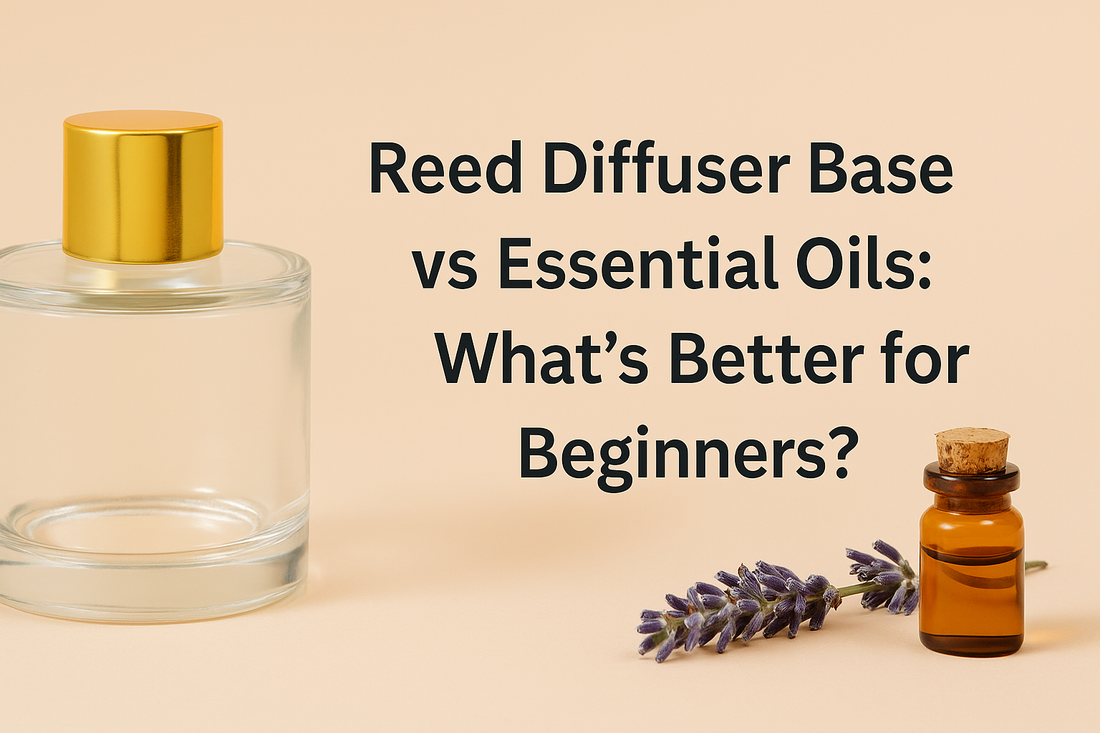
Reed Diffuser Base vs Essential Oils: What’s Better for Beginners?
Share
If you're just stepping into the world of home fragrance, chances are you’ve been torn between two alluring options: a professional reed diffuser base and all-natural essential oils. Both have their fans. Both have their place. But as a beginner—especially if you’re building a business—one offers clarity, consistency, and calm. The other? Potential chaos.
Let’s walk through the truth, with no fluff, so you can create with confidence.
What is a Reed Diffuser Base?
A reed diffuser base is a pre-formulated liquid that acts as a carrier for your fragrance. It’s designed to evaporate at a controlled pace and carry your scent upward through reed sticks. Think of it as the backbone of a reliable diffuser.
Benefits:
-
Already balanced for evaporation
-
Designed for consistent scent throw
-
Blends easily with fragrance oils
-
Long shelf life
What are Essential Oils?
Essential oils are natural plant extracts. They’re potent, aromatic, and often marketed as therapeutic. While many assume they’re the obvious choice for diffusers, they come with a set of beginner traps.
Common issues with essential oils:
-
May separate in base
-
Scent throw is often weak or short-lived
-
Some oils clog reeds or degrade over time
-
Higher price point, lower stability
Scent Throw Showdown: Which Performs Better?
| Criteria | Reed Diffuser Base + Fragrance Oils | Essential Oils Only |
|---|---|---|
| Scent Throw | Strong, consistent, room-filling | Soft, fades quickly |
| Evaporation Rate | Optimized for longevity | Too fast or too slow |
| Compatibility | High with professional materials | Risk of separation/clogging |
| Ease of Use | Beginner-friendly | Requires trial & error |
| Shelf Life | 12+ months | 6-9 months max |
Why Most Beginners Fail With Essential Oils
You’ve mixed your oil. Poured it into a pretty bottle. And... nothing.
That’s because essential oils, when used without proper carriers, evaporate unevenly, give poor scent throw, and sometimes settle at the bottom. They’re meant to be diffused with heat or ultrasonic methods—not passively through reeds.
Also: some essential oils are phototoxic (dangerous when exposed to sunlight), and many will stain or warp your packaging if not handled carefully.
When is it Okay to Use Essential Oils?
If you’re:
-
Making diffusers for personal use only
-
Willing to experiment
-
Comfortable with shorter shelf life and lighter scent
Then yes, you can explore essential oils.
But if you’re:
-
Launching a product line
-
Selling to customers or stores
-
Seeking consistent results and professional aesthetics
Then go with a professional diffuser base every single time.
The CSI Advantage
CSI offers 5 ready-to-use diffuser bases—each tested in Indian climates, beginner-friendly, and created to solve different needs:
-
Pure Performance Base: Simple, versatile
-
Longevity Base: For long-lasting throw (perfect for cars)
-
Lift Base: For florals and airy blends
-
Depth Base: For warm, festive aromas
-
Softness Base: For clean, musky, or powdery blends
No alcohol. No mystery ingredients. Just performance.
Final Verdict: What Should a Beginner Use?
If your goal is:
-
Strong scent that lasts
-
No reed clogging
-
Professional results that customers rave about
Then skip the essential oil rabbit hole.
Start with a pro-grade base. Focus on storytelling, packaging, and brand building.
Your customers don’t just want natural. They want effective.
And remember:
Don’t let the DIY aesthetic cost you your first sale.
Diffuser bases were made for makers. Essential oils were made for diffusers.
Choose like a business. Blend like an artist.